
Orwell: 2+2=5: Film review

Local Contributor
18 January 2026, 1:00 AM
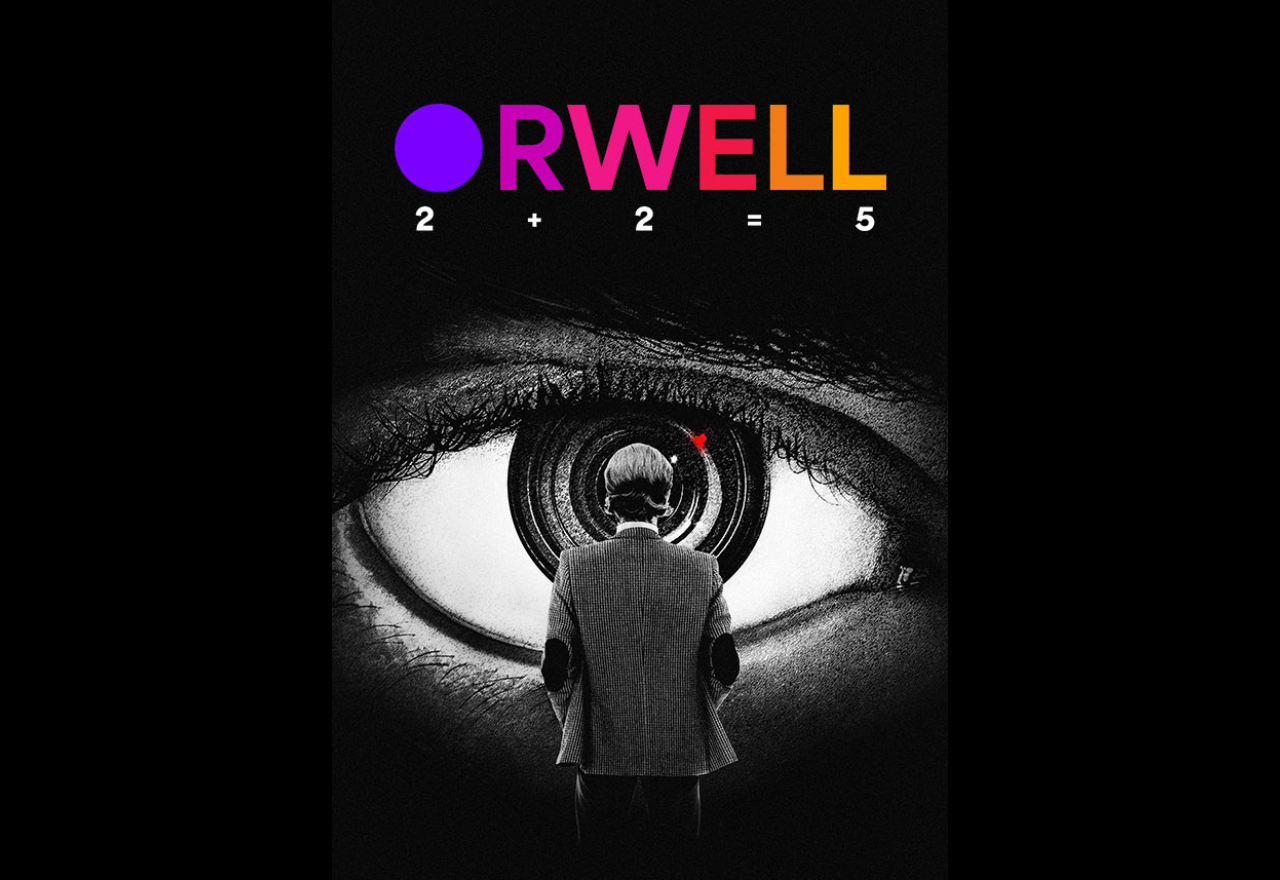 The films poster.
By Darcy Moore
Raoul Peck’s ambitious new documentary pays homage to George Orwell’s intellectual achievement by exploring contemporary manifestations of the authoritarianism the writer so deplored.
Since his premature death from tuberculosis in 1950, Orwell’s novels and essays have become authoritative primers for several generations of readers seeking insight into the dark arts of political propaganda, surveillance and the oppression of citizens by the state. Culturally, Orwell’s flame has never burned more brightly or been more pertinent for readers, regardless of where they stand on the political spectrum.
It took a few seconds - when first viewing the documentary at the Sydney Film Festival - for it to dawn that the opening imagery was magnified tuberculosis bacilli, the bacteria which ended Orwell’s life prematurely in 1950. This becomes an ominous visual motif throughout the film.
Italo Calvino’s adage, ‘a classic is a book that has never finished saying what it has to say’ is particularly pertinent to Nineteen Eighty-Four, published just months before Orwell’s death. The novel coined a lexicon of terms for describing life in a totalitarian state, including the concept that sometimes citizens will be asked to accept that 2+2=5.
Haitian born and formerly the Minister of Culture in that country, Peck is a filmmaker who has experienced dictatorship and oppression. Best known for I Am Not Your Negro, the Oscar-nominated documentary about the writer James Baldwin, Peck’s corpus of work has interrogated the politics of colonialism, Apartheid, racism, genocide and revolution. His sophisticated documentaries aim to broaden how the viewer interprets history and understands contemporary politics.
The script deftly intertwines narration of excerpts from Orwell’s fiction, essays, journalism, diaries and letters by the well-known actor Damian Lewis with contemporary and historic footage from a vast range of archival sources. The biographical fragments in Orwell’s writing are difficult to represent visually as there are no known audio or video recordings, except for a few seconds of him as a boy attending Eton College. Good visual use is made of the film adaptations of Orwell’s novels and the relatively few photos of him in existence.
The Crystal Spirit: Orwell on Jura (1983) is used to overcome this challenge of the lack of footage. Directed by John Glenister, written by Alan Plater and starring Ronald Pickup, the film was shot on Jura and at Barnhill, Orwell’s remote farmhouse where Nineteen Eighty-Four was written. Pickup, who prepared for the role by meeting with Orwell’s surviving friends and family, manages to capture the writer’s ironical sense of humour and gentleness. The clip where Orwell asks his son Richard what does 2+2 equal and then explains some people, ‘usually they’re called governments, great leaders and it becomes very important to them that the people should believe the answer is 5…’ is very effective in the early part of the documentary.
The political appeal of autocratic leaders in democratic countries, who are increasingly unconcerned by conventional notions of the rule of law – such as Donald Trump, Viktor Orbán and Narendra Modi – is a prime concern for Peck, as is the growth in the personal power of Xi Jinping and Vladmir Putin.
There are memorable archival interviews with Milan Kundera, Pierre Bourdieu and Edward Snowden and lengthy clips of congressional hearings where Mark Zuckerberg flounders endeavoring to dodge intelligent questions about Facebook/Meta not complying with their own policies.
Graphics showing the contemporary history of book banning in democracies are juxtaposed with footage of book burning in Nazi Germany and support for such behaviour from American political leaders.
Peck unpacks how propaganda is used to justify the invasion of Ukraine, ethnic cleansing in Myanmar and George W. Bush’s bald-faced and inaccurate insistence that Saddam Hussein had developed weapons of mass destruction in Iraq.
It is odd that there are no captions naming which of Orwell’s texts is being read by Lewis. All the other sources are supported with captions. The end credits do not list which of Orwell’s works have been consulted. Maybe one reason is the way Orwell’s own words have been edited in the documentary. His sentences have been re-arranged and occasionally different texts are joined together. Purists may not intellectually sanction this interference with Orwell’s text – which continues throughout the film - but Peck does not misrepresent him.
Orwell: 2+2=5 deserves the critical plaudits it has received. Former president of the USA, Barack Obama, included it in his list of best films for the year. It has been described by some critics as “indispensable”, “vital” cinema.
This stylistically accomplished, often poetic two-hour film essay is intellectually challenging but will prove rewarding for most viewers, including those unfamiliar with Orwell’s life and work.
My only genuine criticism? We needed Peck’s documentary 25 years ago!
The film has opened in Sydney and will be screened at the Gala in coming weeks.
NOTE ON THE CONTRIBUTOR
Darcy Moore lives in Kiama. He received the 2024 Peter Davison Award for his distinguished research into the life and writings of George Orwell. His writing is available at darcymoore.net and his X/Twitter handle is @Darcy1968. Darcy welcomes correspondence: dfjmoore@gmail.com.
NEWS